

The State of Tech in 2025: AI Breakthroughs, Quantum Milestones, and the Future of Devices
The State of Tech in 2025: AI Breakthroughs, Quantum Milestones, and the Future of Devices
The tech landscape in 2025 is nothing short of revolutionary. With artificial intelligence edging closer to human reasoning, quantum computing showing practical promise, and AR/VR devices blending seamlessly into our daily lives, the pace of innovation is faster than ever. This year, we are witnessing a rare convergence: hardware, software, and human experience are evolving in harmony — or at least trying to.
Let’s break down the key developments shaping the future right now, and how they’re impacting the tech ecosystem as we know it.
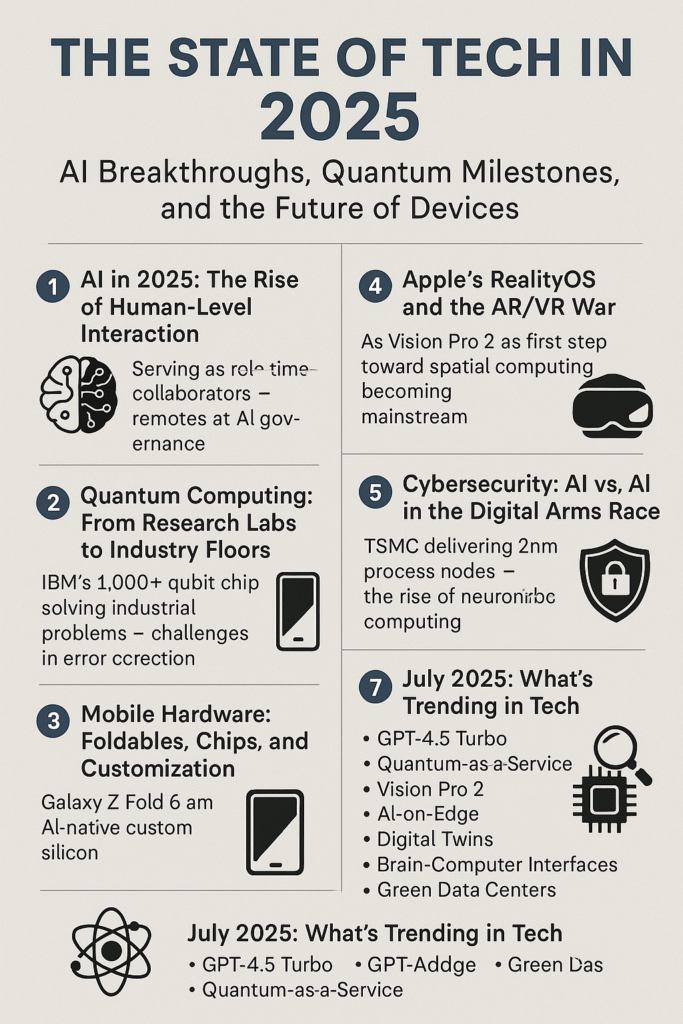
AI in 2025: The Rise of Human-Level Interaction
The release of GPT-4.5 and other foundational models has brought a leap in contextual understanding, reasoning, and multi-modal capabilities. OpenAI’s “memory-aware” models now serve as real-time collaborators in coding, customer service, healthcare, and even legal research.
Meanwhile, open-source models like Mistral AI, LLaMA 3, and Groq LPU are challenging the big players, offering lightweight, private alternatives optimized for edge devices.
But this rise also comes with ethical tensions. Misinformation, deepfakes, and overreliance on automation have sparked global debates on AI governance. The EU’s AI Act, passed earlier this year, is a direct attempt to regulate foundation models, while India and the U.S. are pursuing more flexible frameworks.
Quantum Computing: From Research Labs to Industry Floors
After decades of theoretical promises, quantum computing has finally stepped into early commercialization. IBM’s 1,000+ qubit chip, dubbed Condor, along with Google’s Sycamore 2, are no longer proof-of-concept — they’re solving niche industrial problems in logistics, material science, and pharmaceuticals.
Companies like Quantinuum and IonQ are offering QaaS (Quantum-as-a-Service), targeting enterprise clients looking for quantum acceleration in simulation-heavy workloads.
Mobile Hardware: Foldables, Chips, and Customization
Samsung’s Galaxy Z Fold 6 and Google’s Pixel Fold 2 have ushered in a new era of flexible devices with durable ultra-thin glass, water resistance, and app optimization.
The smartphone market is also seeing a shift toward custom silicon. Apple’s A18 Pro and Google’s Tensor G4 showcase how companies are designing chips not just for performance, but for AI-native computing.
Apple’s RealityOS and the AR/VR War
Apple’s Vision Pro 2, running realityOS 2.0, is now seen as more than a luxury headset — it’s the first step toward spatial computing becoming mainstream. With mixed-reality environments for work, travel, and entertainment, the Vision series is being adopted in design studios, hospitals, and film production.
Meta, not to be outdone, has responded with Quest Pro Max, boasting retina-level resolution and real-time AI scene generation.
Cybersecurity: AI vs. AI in the Digital Arms Race
As AI becomes more prevalent, so do AI-powered cyber threats. Deepfake scams, generative phishing, and autonomous malware are forcing cybersecurity firms to turn to defensive AI.
Startups like Darktrace, SentinelOne, and CrowdStrike Falcon AI are investing heavily in LLM-driven threat detection. Adaptive learning is replacing rule-based filters.
Semiconductor Innovation: Is Moore’s Law Rebooted?
2025 has seen major breakthroughs in chip architecture. Companies like TSMC and Intel are producing 2nm process nodes, while startups like Cerebras and Graphcore are pushing beyond CPUs with wafer-scale chips.
The emphasis is now on vertical stacking, chiplet designs, and neuromorphic computing — systems that mimic the human brain’s parallel processing.
July 2025: What’s Trending in Tech
To wrap up, here are the most searched and viral keywords in tech this month:
Final Thoughts
The second half of 2025 is defined by convergence: AI, quantum, mobility, and immersive experiences are no longer separate disciplines — they’re components of a unified digital life. For tech professionals, this is both a thrilling and daunting era. The need for lifelong learning, ethical awareness, and agility has never been greater.